
More than a year ago, I wrote a blog about “rescuing” crocheted, knitted and quilted/sewn blankets that I came across in resale or thrift stores. Those “rescues” were primarily bigger blankets and were donated to a local Veteran shelter that serves Veterans who are in transition from homelessness or substance abuse issues. As a Veteran myself, I have a soft spot for my fellow brothers and sisters in arms – especially when they are struggling.
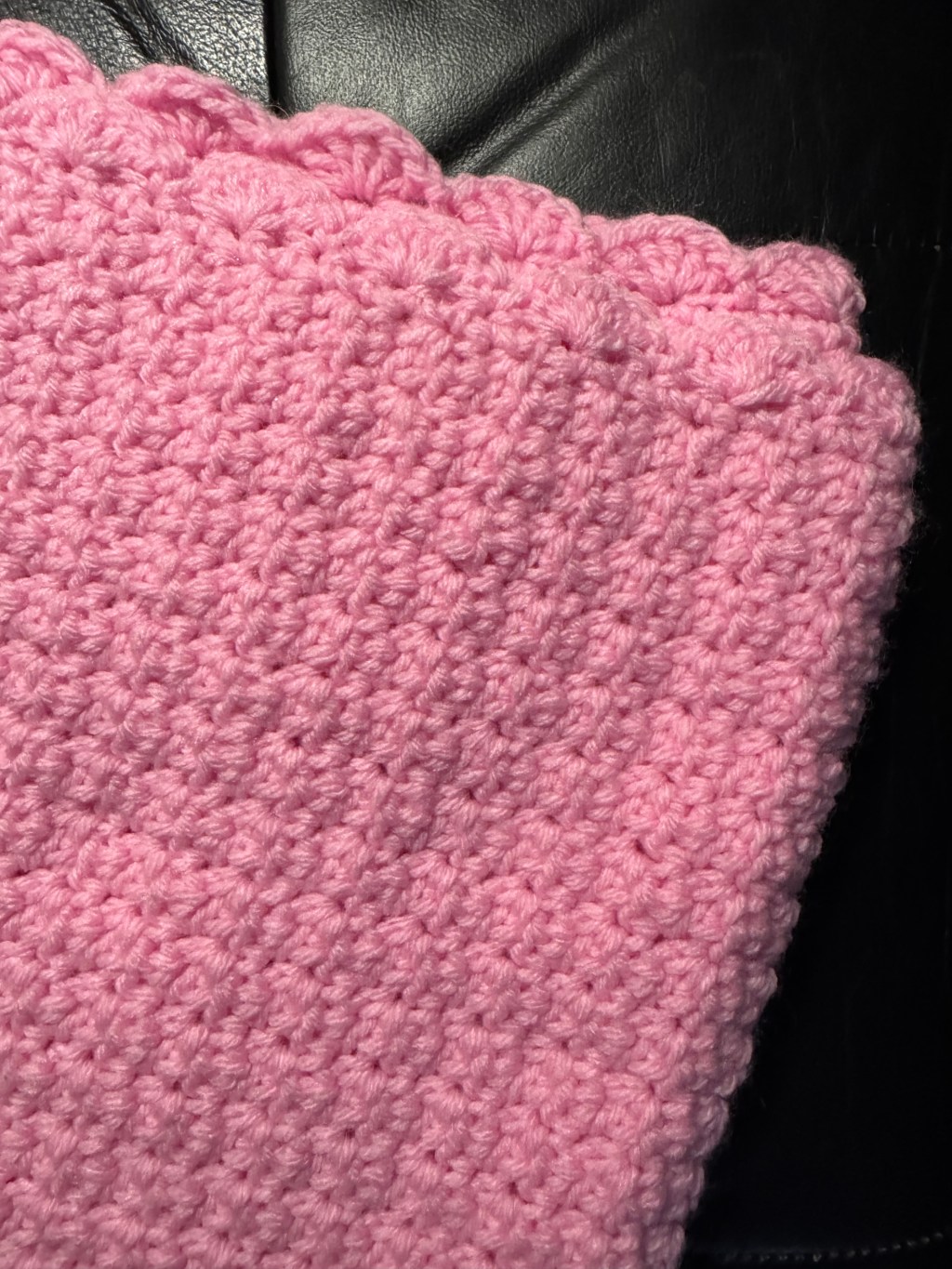
At that time, I did not pick up any “baby” blanket sized items, except for one that I just couldn’t give to the shelter. I had judged that one as not being of much interest to the Vets there, so it stayed with me. Today, my kitty, Miss Lena, enjoys the warmth it provides in the cooler months and the softness year round as it sits on a chair in my living room. I have discovered that she often sleeps there at night in between her nocturnal shenanigans.

The quilt has a soft, flannel purple side, a pick edging which appears to have been hand-stitched all around, and a lovely floral-inspired design on the other side (cotton) and is yarn tied throughout (you can see 1 yarn knot at the bottom of the photo above).
As a crocheter, knitter and sewist, I know what went into picking out the fabric and/or yarn, and assembling each piece, and while I work hard to NOT be judgmental, I have to admit that a little part of me absolutely IS judgmental when I see these items – not well-loved and worn, but almost new – in resale and (especially) thrift stores.
When I am in a thrift store, I always head to the area where blankets and linens are kept and look for potential rescue items. If I am seeking to get some for donating to charities like the Veteran’s shelter I noted above, I get any one that is in decent shape. If I am NOT on one of those missions, I look for baby-sized blankets in excellent condition.
I’m certain that my interest in these is multi-faceted. First of all, I am a helpless fabric and yarn fanatic, and truly love items that are crocheted, knitted or sewn by an individual and not mass produced. I am also very interested in the disconnect between the time, talent and heart that go into making something for someone as a gift – and that gift ending up in a thrift shop in a very obviously unused and (seemingly) unappreciated condition.
Even a small knitted or crocheted blanket is a piece that took someone HOURS to make. The materials. though not insignificant, are less of a factor than the time someone spent, sitting and concentrating on making something to give to another person. Let’s look at the estimated WORTH of something that is crocheted or knitted and gifted, based on the time.
By my calculations, with some help from my AI Co-Pilot, it takes approximately 15 to 35 hours for someone with intermediate skills in crocheting or knitting to complete a small blanket, with an estimated finished size of 36″ x 48″.
For someone who works in a job and makes $15/hour (~$31,000/year), this means that their “homemade gift” represents – at a MINIMUM (15-hour project) – a gift with an opportunity cost of $225 and that’s just considering the stitching time.
Opportunity cost is simply the value of what you give up when you choose one thing over another, … Because resources (like time, money, or energy) are limited, every choice means giving up something when a choice is made.
For someone whose work earns $50/hour (~$104,000/year), that same gift jumps to a minimum opportunity cost of $750 – again, just calculating the stitching time.
- NOTE: this is simply a way to tabulate estimates on what was put into a hand-made gift based on time; it is not an attempt to value people’s creations based on their earning potential.
For a more complex or larger project (~35 hours), the cost quickly rises to between $525 and $1,750 with the same metrics as above. An average of the time (25 hours) makes the considerations fall between a $375 and $1,250 as the opportunity cost for hourly pay ranges from $15 to $50.
I think about this a LOT when I see handmade and obviously new items in the thrift store.
Did the person crocheting or knitting that blanket really intend to give a gift of several hundred dollars? I’m guessing in many cases the answer to that question is NO. Therefore, it’s time to start considering the tradeoffs of our time and creative energies around gifting.
Using the basic time calculation for a crocheted or knitted item (15 to 35 hours for a baby blanket-sized piece), estimate the opportunity cost for the item you plan to make, and ask yourself this:
“If I were going to go shopping for this gift, what would I spend?”
Then, compare this number to the calculation of the TIME VALUE you would invest if you would make something.
If the recipient is in our $50 – $100 gift recipient category, does it make any sense to invest $375, $525 or more on a gift?
I contend that the answer to that question is a solid NO.
This is not intended to be a cheap-skate way of looking at gift-giving: this is a cold, hard business decision. Our TIME alone (I’ve not even addressed the issue of talent) should be evaluated when we consider making someone a gift.
I will confess that these numbers have caused me to look back on a number of hand-made gifts that I have given over the years, and feel some twinges of regret, but regret is counterproductive so I won’t linger there. I do want to address the “elephant in the room” at the core of this issue, though:
- the perceived value of activities that are deemed “women’s work“
History and sociological research have documented that there remains an underlying societal opinion on the VALUE of crocheted, knitted and sewn items and other textile crafts. These activities have been traditionally associated with (unpaid) domestic labor, which is often viewed (inaccurately) as less economically valuable compared to industrial or “professional” work. Also, since these are/were often associated with women’s roles in the home, they are often dismissed as hobbies rather than skilled artistry. Hand-made items are often expected to be cheaper, even though they require significant time, skill, and creativity.
I understand cleaning out a home that is being sold after a death in the family, and not knowing what to do with the piles of afghans and blankets that Great Aunt Ethel left behind. Hopefully, the family took ones that meant the most to them, and then donated the rest. I also understand that SOME of these baby blankets may have been prototypes that someone made and never gave, however; I think that is a rare occurrence.
I recognize what went into making each of these, so perhaps “rescuing” them is my way of honoring that, and yes – I understand that the people who made these blankets will never know. Maybe this is more about me honoring my own efforts by proxy, which is probably a good conversation for a therapy session.
My most significant takeaway from the experience around finding these items has been my pivot on gifting. I have learned to think intentionally about the gift I plan to give, and to value my time, my effort, my creativity and my talent, first. Then I can make the decision on what I will be spending on a gift for the occasion and person, and move forward from there.
It’s another New Year, and the time when we all think about making resolutions, implementing changes, and improving our lives. I can think of NO BETTER GOAL than for fiber artists everywhere to start valuing ourselves more fully.
We can still make things for others, but let’s start looking honestly at the TRUE value of those gifts, and make sure we are gifting our precious time and talent to those who will truly appreciate them.
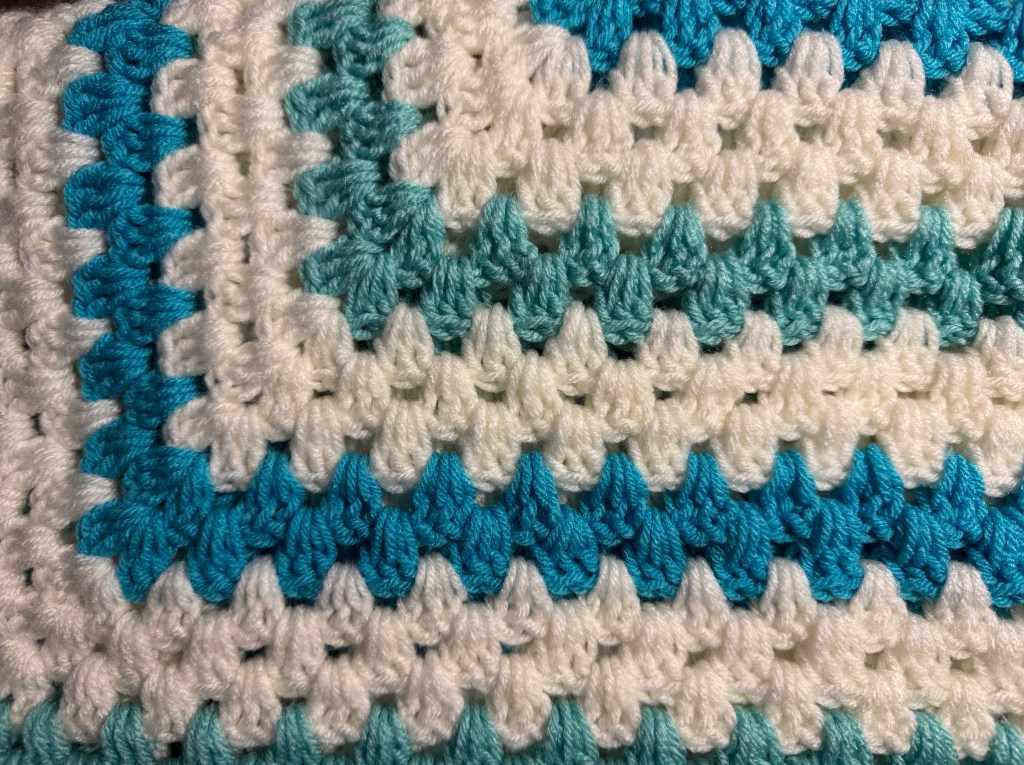
Lastly, when you consider how many items donated to thrift stores end up in landfills, this little “project” of mine has much wider implications!
(C) 2026 Fiber Harmony / Stitch ‘n Dish
all photos in this blog post show items that were “rescued” from thrift stores
 Fiber Harmony (Stitch 'n Dish)