
I have started to see posts and online conversations around one “elephant in the room” in the sewing and quilting community, specifically. That elephant is the extreme cost of many of the machines that are widely promoted.
Before I go any further, let me state emphatically that I don’t give a HOOT what other makers BUY or use. That is a personal choice. This blog post is about what I see as a BIGGER issue: the impact to the fiber arts community.
I’ve been having these conversations in my circle for a while. In fact, a couple years ago – before any hints (in the public, anyway) that a world without Joann might be possible, my sister and I were shopping a larger, “etc” Joann store and stopped by the Viking section to browse. Both of us sew, are fairly skilled at it (my sister much more so than me), and have toyed at different times with getting an embroidery machine. We are also both technically proficient as our jobs are in sectors that require it, so we have never been “anti-computer” in any area of our lives.
We enjoyed our chat with the Viking sales representative and then asked for the selling price. Both my sister and I are educated, with solid white-collar jobs that make good salaries, and we both almost choked on the price tag of $22,000.
We asked how average fiber artists – you know, the ones that shop Joann stores for fabric instead of the local quilt shops – were affording those price points, and she said that most people are lifelong customers, who trade in and trade up as new models come out. She also noted that Viking offers financing, which means they are happy to collect even MORE money from you in the form of interest on the loan for your purchase.
Questions began to bubble up and my sister and I mused about whether there was so much profit in the sale of a single big machine that they can afford to sell a few here and there? Or are they assuming that people will want to continually upgrade and invest in increasingly more complex and expensive machines? Or is it something else?
We both use basic machines, which means we thread our own needles, wind our own bobbins, and cut our own thread. To be honest, I haven’t had much need in my own sewing adventures for functionality beyond this. I remember attending a sewing project workshop at a local fiber fest a year or so ago and using a brand name machine that did a lot of those things automatically. It sewed the same straight and zigzag seams that my basic Singer and Kenmore machines do, but I was curious enough about the price difference that I looked up the selling price for the model. These “low end” machines were “only” $2,500 and I almost fell out of my chair.
The instructor also informed us that there was a show deal on these where we could purchase one at the end of the festival for $1,700. This was a nice discount, but even after working with this lovely machine in the class, I didn’t see that it did anything that justified the expense – especially when I have 2 perfectly functional machines at home.
Let’s step away from the issue of COST for a minute and dig into a deeper issue: how are these “super computer sewing machines” impacting the art of sewing and quilting?
Before I answer that question, I want to dial back the Time Machine to 1988. I was a young wife and mother, fresh out of the US Navy. I was struggling as we had moved to a new community, and the adjustment from military to civilian life was a challenge. At that time, I was the lucky recipient of a Bond Knitting Machine. I was interested in knitting, and had taken a knitting class at the local yarn shop. I believed that adding this new fangled knitting machine to my fiber activities would be a dream come true.
I learned how to use it, bought accessories to make the various tasks easier, and made a lot of things over the years. But,… today that knitting machine sits in pieces in a box, in my basement. I found that while cranking out quantities of stockinette stitch pieces was indeed much FASTER on the knitting machine, it did not do anything to improve my basic knitting skills. It did not make me a more experienced hand knitter, and it was, in many instances, more frustrating than it was satisfying.
I didn’t have the language to describe it back then, but today I can say that while the machine knitting created large swaths of knitted yarn, it entirely circumvented the PROCESS of knitting. This meant a loss of the benefits gleaned from knitting – which I have written about in a few previous blog posts. Using a knitting machine felt more like manufacturing and production than an artistic process.
I have had similar thoughts about the process involved in creating various fiber arts pieces, especially when I look at the very busy, (mostly) machine done blankets, wall hangings and other quilted pieces on display at various quilt and fabric shops. My great-grandmothers made quilts, using fabric from recycled aprons, dresses, shirts, and other cloth. They pieced them, and quilted them by hand. This was usually done in a group that included family members, neighbors and friends as they sat around a large, wooden quilting frame (that we still own). All of us have at least one of these truly-handmade quilts, and they hold a lot of memories and meaning for each person.
In the same way that my machine knitting didn’t feel like knitting, I struggle to see computerized sewing and quilting as the true art of sewing. If it stopped there – my opinions vs. others – it would be just that: an opinion. But, what about the impact on the larger fiber arts community? What messages are we sending to the younger generations about the fiber arts?
In the remainder of this post I am focusing on the sewing machine corner of fiber arts. The reason? Knitters seem to have voted with their needles, and today we find knitting machines to be less popular than hand knitting, which is growing in popularity among younger generations.
My interpretation of the subtle messaging around sewing, and quilting includes:
- quilting is a “pay to play” activity
- s/he who has the biggest/newest machine, wins
- if you’re not spending a lot of money, you’re not doing it “right“
The challenge I see with these money-heavy messages is that the up and coming generations are going to have much less disposable income than the millennials and Gen X have. They are going to be focused on finding affordable housing, paying for an education (~39% of Gen Z has/will have significant student loan debt), and finding a decent job after graduation.
These are not people who are going to entertain a $2,500 sewing machine – let alone one that retails above $10,000. But look around at your local fabric and quilt shops today: how many of them are beginner-friendly? Budget-aware? Invested in the art form of quilting and sewing over and above the sale of an expensive machine?
Now, I get it. Owning a small business is not easy! I understand that for many in the quilt/fabric shop space, even sporadic sales of those pricey machines probably keep the doors open. So I am sympathetic to the need that those big ticket items meet, but does it have to take over and “brand” the entire movement?
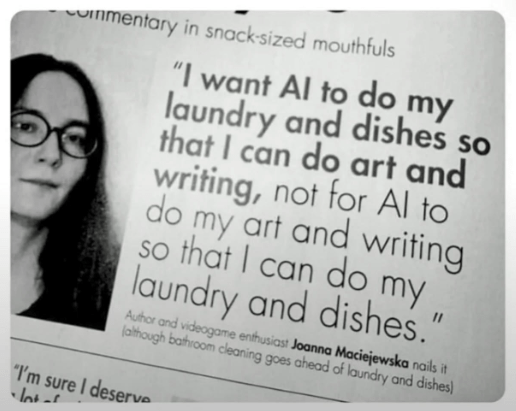
The graphic at the top makes an important, related, statement about AI. Most of us are happy to have technological answers to redundant questions, and technology solutions to work that is boring, dangerous, or repetitive. We DON’T want technology to take over the things in life that bring us joy. This is what I see in the ever-increasing cost of sewing machines. We are, in essence, being asked to PAY for technological solutions to creative tasks that really don’t NEED to be solved, and in the process, I fear, pushing access to these wonderful skills further and further away from the younger generations.
In closing, I do NOT suggest that all serious quilt and fabric stores stop selling pricey sewing machine models. I do, however, suggest that we all reconnect with what is IMPORTANT to us about our fiber arts practices, and make better choices to support the fiber arts community overall.
If we do not recognize this, and start to pull back some of the more egregious capitalistic urges that have embedded themselves in our midst, I worry about the future for those who find solace in fabric and yarn, and take comfort in the soft clicking of needles or rhythmic pace of a sewing machine.
There’s a lot at stake; let’s move forward with more intentional focus on the ART forms that are at the heart of every fiber arts practice and process.
(C) 2026 Fiber Harmony / Stitch ‘n Dish
 Fiber Harmony (Stitch 'n Dish)