
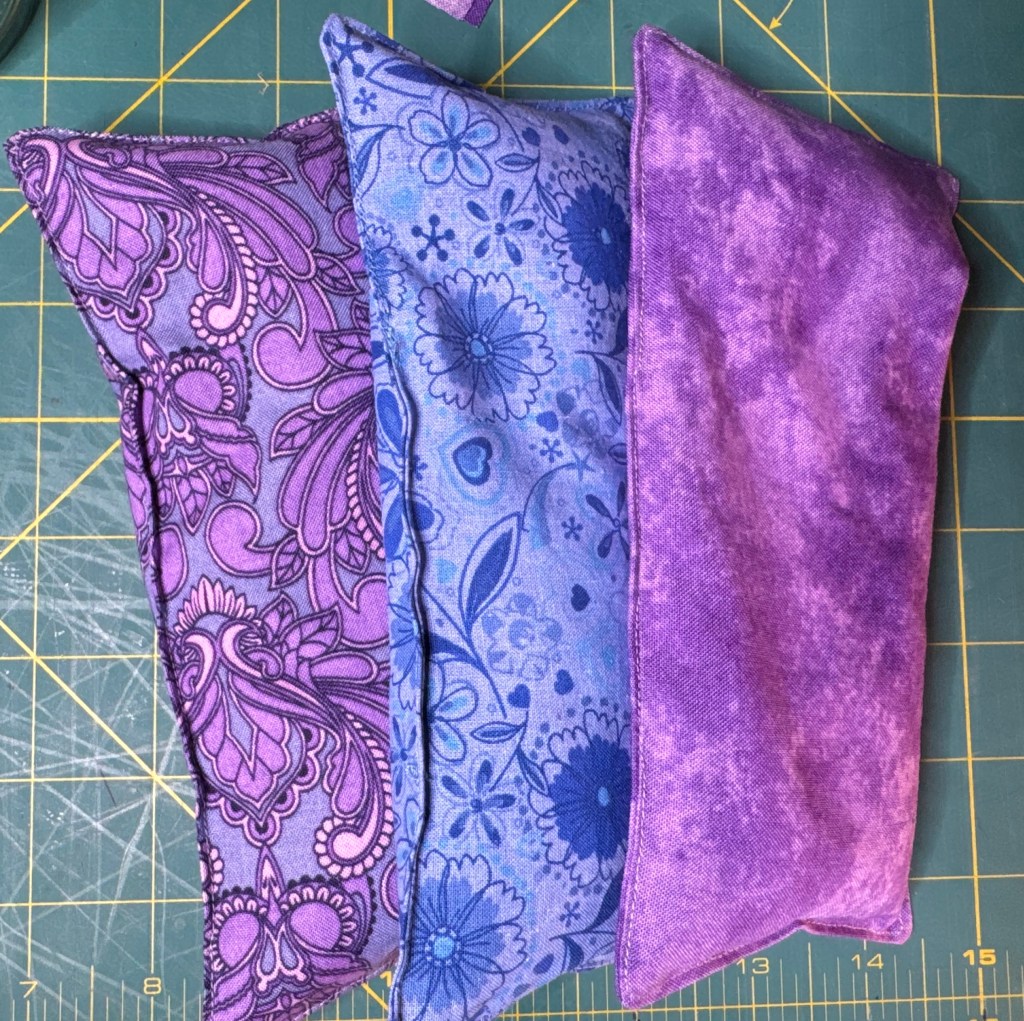
Among the gifts with the most commentary this year, my VERY last minute lavender eye pillows took the prize! Since they saved my bacon when time ran short at the end of the holiday shopping window, I wanted to share my recipe, and the pattern.
These are so simple that if you have the ingredients – or some reasonable facsimiles – you can whip these up in the morning before your afternoon engagement (I created a pdf you can download for free. It’s available at the bottom of this post).
NOTE: with all my bluster about stashbusting, I have to admit that my tendencies to not donate, give away, or throw out any crafting supplies saved my butt this year.
Making an Eye Pillow
I started with laundered (clean) cotton fabric scraps that I was able to cut into 4″ x 8″ strips. Place one piece on top of the other, right sides together, and align all sides. Stitch around using a ¼” seam.
Be sure to leave an OPENING to add your ingredients on a longer side; clip the corners, taking care not to cut through stitching.
Turn right-side out and press (I use a knitting needle or crochet hook to push out the corners).
Using a 1/8” seam allowance, top stitch around, taking care to leave the opening area unstitched. If the corners didn’t turn with a sharp 90-degree angle, ease around and round them. Due to the nature of the piece, as long as it’s neat, this will not be noticeable and in fact, for a comfort item, softer angles are preferable anyway.
Now it’s time to fill with your prepared mixture. I used the same measuring tablespoon (TBSP) that worked for preparing the mixture. Funnels are also an option but depending on your ingredients, this may or may NOT be ideal.
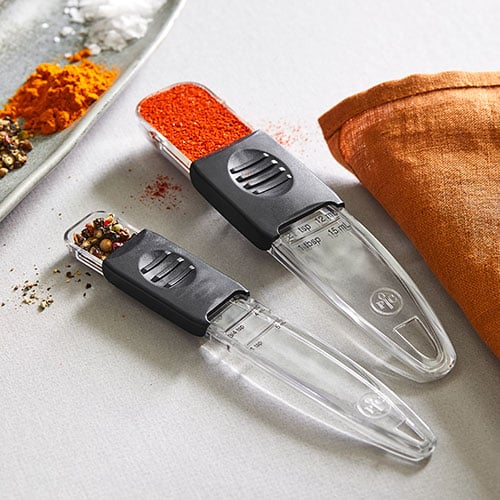
NOTE: I happened to have a Pampered Chef measuring spoon that was IDEAL for this. I had purchased it at a party years ago. (no affiliation – just sharing what worked for me)
Be sure you leave room to close AND top stitch across that opening.
I secure the contents before that final top stitch closure by placing a long straight pin or 2 across the opening and far enough away to not interfere with my presser foot when I add that final top-stitching across opening. Also, I start and stop about ¼” on top of the initial top stitch around AND back stitch over start and stop of this step to secure stitches.
Eye Pillow Fillers
I asked my AI co-pilot to suggest a couple recipes for these eye pillows and listed the ingredients I had in-house. Keep in mind that this was Christmas Eve afternoon and the LAST thing I wanted to do was to venture out toward any shopping areas, or stores!
Here’s the one I ended up using for my last-minute, add-on/extra Christmas gifting this year.
Lavender Eye Pillow – filling
Total filler: ~1.25 cups
Ingredients:
- 1/2 cup flaxseed (raw, whole – not ground)
- 1/4 cup long-grain rice
- 1/4 cup lavender-scented buckwheat hulls
- 2 tbsp dried lavender buds
Mix together to distribute all the ingredients and fill the eye pillow.
Some notes:
- Flaxseed holds the lavender scent well
- Rice adds a gentle weight without heaviness
- Buckwheat hulls improve airflow and softness
- Don’t overdo the scent since this is for use in the eye area
- I put 3 drops of the Essential Oil on a cotton ball and place 1 or 2 in a closed jar with some buckwheat hulls. It doesn’t take long to impart a gentle essence of the scent.
- To directly apply an Essential Oil to a filler (e.g. flaxseed), ALWAYS make a 1% dilution.
- 1 drop of EO in 1 tsp of a carrier oil (almond or coconut oil.)
- Mix thoroughly with the flaxseeds to distribute throughout
I placed each eye pillow in a plastic bag (think zipper-lock sandwich bag) and included a little instruction card that I had created.
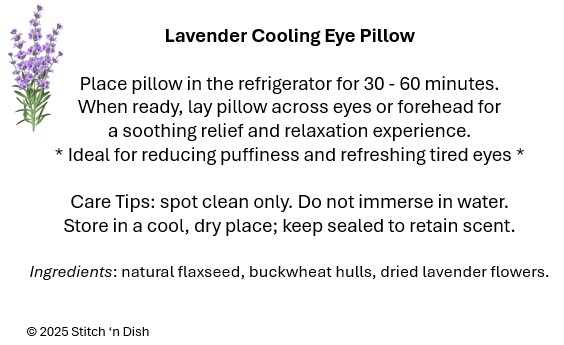
Again, let me be clear that at this last minute, I did not just “whip this up” on my own. I used AI to assist me and asked a number of questions about the ingredients, proportions, risks and rewards of using various options, and I even asked it to draft the insert cards.
I edited all of the output, but it was extremely helpful to have a DRAFT with which to begin.
I see this type of use of AI as the ideal – a supplemental TOOL for human use. I did not have the bandwidth to be creative, and I was under a time crunch. In this situation, my ability to use an AI tool made it possible for me to put together 4 last minute gifts of quality that were among the most well-received of my gifts.
I view this in the same way that I look back on the emergence of the personal calculator, which was absolutely SCANDALOUS when I was in school (K-12). My grandmother thought that if you couldn’t add the cost of the items in your grocery cart, apply the expected tax to them and know what was needed before you got to the checkout line, to the penny, that you weren’t “good at math“.
I laugh at this now, because while that was a laudable skill in the early 1960’s, the world has changed since then – significantly! The same goes for Excel when it became popular in the 1990’s. Yes, the skills needed to add your cart of groceries up or prepare a financial statement are now largely done by tools, but we still need to understand the CONTEXT, or the output is useless to us.
My AI tool could have put all of this out in front of me, but if I didn’t have the knowledge, skills and abilities to take the information and put it together, it would have been no help to me at all.
I know that the conversation about AI and how it helps AND hurts us in various sectors of the economy and life will continue and escalate into the New Year. For now, however; I’m grateful that I had access to a tool that helped me put the finishing touches on my holiday gifting.
I hope everyone enjoyed the warmth and wonder of holiday celebrations with family and friends. The New Year lies ahead, promising 12 more months of crafting, creativity, fiber arts, and joy!
(C) 2025 Fiber Harmony / Stitch ‘n Dish
 Fiber Harmony (Stitch 'n Dish)